
 한국어
한국어 日本語
日本語 中文
中文PDLC smart film
A smart window film that adjusts the transparency of glass electrically. It turns a single pane into a screen only when you need one.
01 Principle
A film that adjusts transparency electrically
PDLC (Polymer-Dispersed Liquid Crystal) and PNLC (Polymer Network Liquid Crystal) are smart window film technologies based on a material that mixes polymer and liquid crystal. When the liquid crystal molecules are ordered, light passes through and the film is clear; when they are disordered, light scatters and the film turns opaque.
PDLC is the one that is clear when powered; PNLC is the one that is clear when the power is cut.
On that principle, the user can switch the film between clear and opaque easily.
PDLC
Polymer Dispersed Liquid Crystal
Clear when powered
- POWER OFF
- Light scatters · opaque
- POWER ON
- Light passes · clear
Film structure
- PET
- ITO
- Liquid crystal ink
Liquid crystal mix · 40% liquid crystal + 60% resin
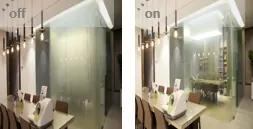
Power off (opaque) / power on (clear) PNLC
Polymer Network Liquid Crystal
Clear when the power is cut
- POWER OFF
- Light passes · clear
- POWER ON
- Light scatters · opaque
Film structure
- PET
- ITO
- Alignment layer
- Liquid crystal ink
Liquid crystal mix · 60% liquid crystal + 40% resin
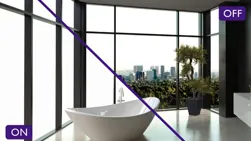
Two states compared across the diagonal of one window

02 Daylight Control
Daylight chosen section by section
Switch a window section by section and one pane gives you daylight and privacy at the same time. The state changes with nothing more than turning the power on or off.
Power ON
Light passes · clear
When the liquid crystal molecules are ordered, light passes through.
Power OFF
Light scatters · opaque
When they are disordered, light scatters and the film turns opaque.
- PET Film
- ITO
- Liquid Crystal · Polymer
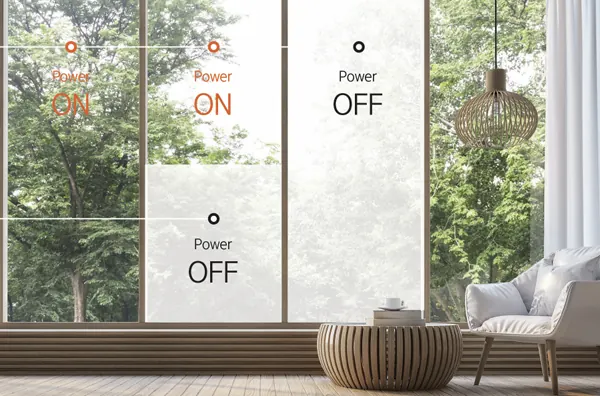
- Switched to suit the user's preference
- Daylight chosen by size and length
03 Features
Product characteristics matched to the site
01
Coating in a range of thicknesses
As the PET film substrate went from 188㎛ to 50㎛, the total laminated thickness fell from 400㎛ to 125㎛.
A thinner PDLC film brought the R value on curved surfaces down markedly. That makes the film easier to handle during installation and when removing debris. It can now also be wound onto a 2inch roll.
The thinner it gets, the lower the curved-surface R value
02
A range of sticky types
The sticky type can be chosen to suit the installation site.
- Glass lamination
- Normal Type
- Sticky, wet application
- Acryl Type
- Sticky, dry application
- Silicon Type
03
Added functions
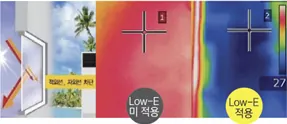
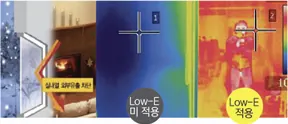
Low-E added to block far infrared better
Insulation and heat rejection
Conventional solar control film achieves heat rejection by absorbing near infrared, that is solar heat. PDLC film combined with Low-E film instead reflects both near infrared solar heat and far infrared heat from indoor heating, so it insulates as well as rejects heat.
Solar control film and Low-E film
Blocks solar heat
300nm ~ 2,500nm
Low-E film
Blocks far infrared (heating warmth)
2,500nm ~ 50,000nm
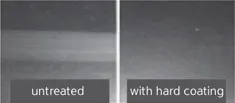
Hard coating to resist everyday scratches
Scratch resistance
A thin coating on the outer face of the film protects it against everyday scratches.
Hardness : 2H
04 Specification
Standard specifications
There are three grades by transparency: White, Light gray and Dark gray.
| Item | Unit | White | Light gray | Dark gray |
|---|---|---|---|---|
| Optical Properties | ||||
| Parallel Light Transmittance (650nm) | ON(%) | 84 | 45 | 25 |
| OFF(%) | 1.0 | 1.0 | 1.0 | |
| Haze | ON(%) | 2.0 | 2.0 | 2.0 |
| OFF(%) | 92 | 92 | 92 | |
| UV Blocking | % | 99.0 | 99.0 | 99.0 |
| Electrical Properties | ||||
| Operating Voltage | Voltage(V) | 60 | 60 | 60 |
| Frequencies | Hertz(Hz) | 50~60 | 50~60 | 50~60 |
| Response Time | ON→OFF(ms) | 10 | 10 | 10 |
| OFF→ON(ms) | 300 | 300 | 300 | |
| Power Consumption | W/㎡ | 5 | 5 | 5 |
| Specification | ||||
| Operating Temperature | ℃ | -20~80 | -20~80 | -20~80 |
05 Applications
Where it is used
Building interiors, facades and vehicle glass are all covered by the same film.
Partition / Blind
Interior
Office windows and meeting room glass partitions switched section by section.
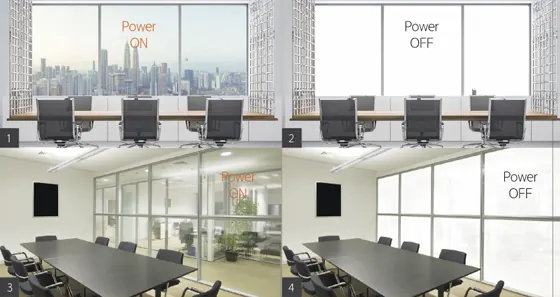
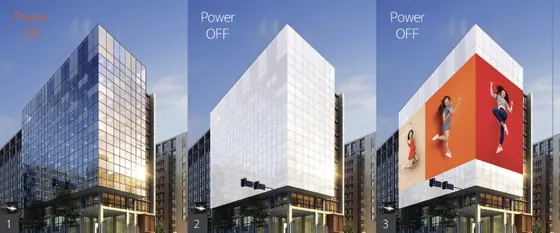
Power ON (clear) / Power OFF (opaque) compared Advertisement
Display
A building facade switched opaque to project advertising onto it.
Power ON (clear) / Power OFF (opaque) compared Automobile
CAR
The transparency of a panoramic sunroof and side glass adjusted at will.
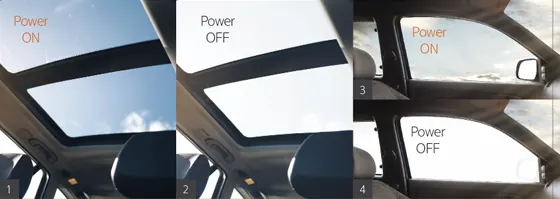
Power ON (clear) / Power OFF (opaque) compared
A smart choice for your business: MRO procurement outsourcing
We can help with whatever you need to evaluate adopting the service. Weekdays 08:30–18:00.